Updated 17 hours ago
kW vs. kWh: Watts, kilowatts, and kilowatt-hours explained
Written by
Ben Zientara
Find out what solar panels cost in your area
In order to understand how solar power works, it is vitally important to know the difference between kilowatts (kW) and kilowatt-hours (kWh).
The difference between them is simple: kW are a measure of power, and kWh are a measure of energy (power output over time). For example, a space heater might require 1 kW of power to turn on. If it runs for one hour, it will use 1 kWh.
When we apply the same concept to solar, we consider the number of kW a solar panel array can generate under full sun. A 10-kW solar array can generate 10 kWh if it gets full sun for an hour.
Of course, if you’re brand new to electricity, there’s more to learn, so let’s dig deeper into what watts are, and the differences between watts, kilowatts, and kilowatt-hours!
What is a watt?
A watt (W) is a unit of power. Think of power as “the ability to do work.” Technically, a watt is a measurement of energy transfer that equals one joule per second, but since nobody outside a laboratory has uttered the word “joule” since high school physics class, we’ll stick with “watt.”
Watts, kilowatts, megawatts, etc
A watt is the basic unit of measurement for power, but when we discuss solar generation or electricity usage in a home, we often talk about kilowatts: equal to 1,000 watts.
When we talk about electricity generation from a power plant, we multiply kilowatts by 1,000 to get megawatts.
Aren’t Latin prefixes neat? Each time you multiply by 1,000, there’s a new one. kilo-, mega- giga- tera-... the list goes on and on.
How electricity is like water
A good way to think about electricity is that it’s a lot like water. Imagine a hose with a spray nozzle on the end. There is pressure in the hose from the water that wants to flow out. If you open the nozzle, the water flows out at a certain rate.
In electricity, voltage is like the water pressure. It determines how much electricity could possibly flow through the system. Amperage is the amount of flow there is. When discussing electricity, amperage is also called current.
The total amount of watts of power is equal to the volts (V) multiplied by the amps (A).
Let’s go back to the water hose. Say the nozzle has three settings: off, low, and high. The water pressure behind the nozzle is constant; that pressure is like voltage. In the off position, there’s no flow, so no power.
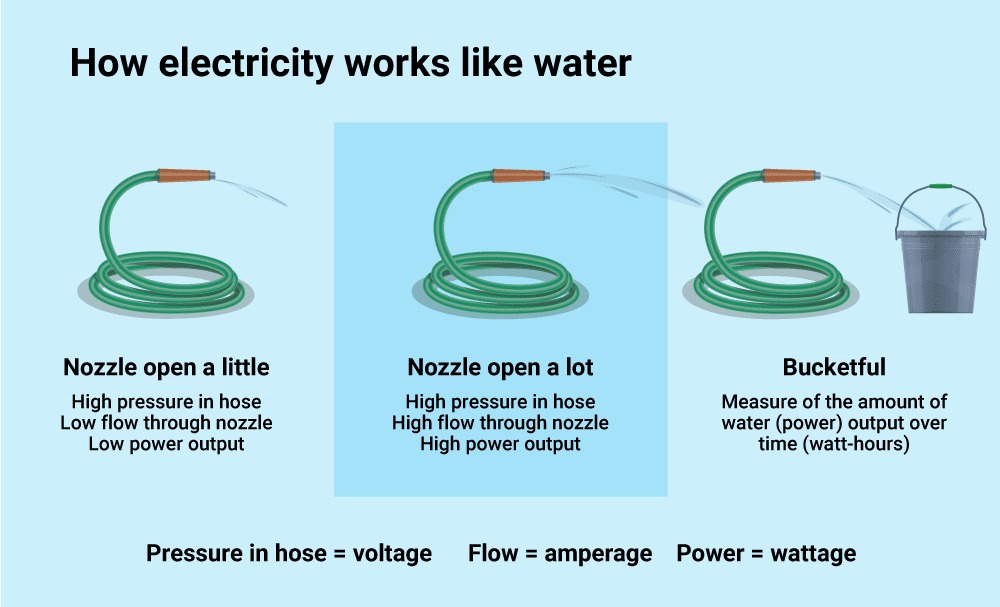
Turn the nozzle on low, and you’ve got power! You’ve increased the amperage and water is flowing. The total flow is measured in gallons per minute, and to return to our metaphor, that flow would be the “wattage”.
Turn the nozzle on high to increase the amperage again, and you’ve got more power; more “wattage”.
Measuring the flow of power
Sticking with the water metaphor: the flow that is coming out is a measure of the power. Point the hose into a bucket for 10 minutes and you’ll fill it up. The water that flowed into the bucket is like a measure of the energy that flowed through the hose.
A common way people interact with watts is through the lightbulb. Say a 100-watt light bulb needs that much power to glow. If you leave a 100-watt bulb on for an hour, you’ve used 100 watt-hours.
Again, a kilowatt of power (kW) is 1,000 watts, so if you leave ten 100-watt bulbs (1 kW of bulbs) on for an hour, you’ll have used one kilowatt-hour (kWh).
This is one reason why switching to more energy efficient light bulbs can have such a great impact. An LED bulb that can make as much light as a 100-watt incandescent bulb only needs 14 watts. That means you can run ten 14-watt LEDs for 7.25 hours and use the same amount of total energy as the incandescent bulbs do in an hour.
With one kilowatt-hour you can power: | ||
|---|---|---|
5 | 100-watt incandescent bulbs | for 2 hours |
21 | 23-watt compact fluorescent bulbs | for 2 hours |
35 | 14-watt LED bulbs | for 2 hours |
Watts, kilowatts and kilowatt-hours: power vs. energy
So, a watt is a measure of power, or the ability to do work, and a watt-hour is a measure of energy, which means the amount of work done over a certain period of time.
A kilowatt is simply a thousand watts, and a kilowatt-hour is a record of an average output of a thousand watts over an hour.
Another way to think about power and energy is a marathon runner. Power is like the ability to run at a certain pace, and the distance the runner covers is the amount of energy they used.
In 2019, the fastest marathoner in the world completed a race in almost exactly 2 hours. That means he put out enough power to consistently run at about 13.1 miles per hour, and the 26.2 miles of the marathon are the measure of the energy he used.
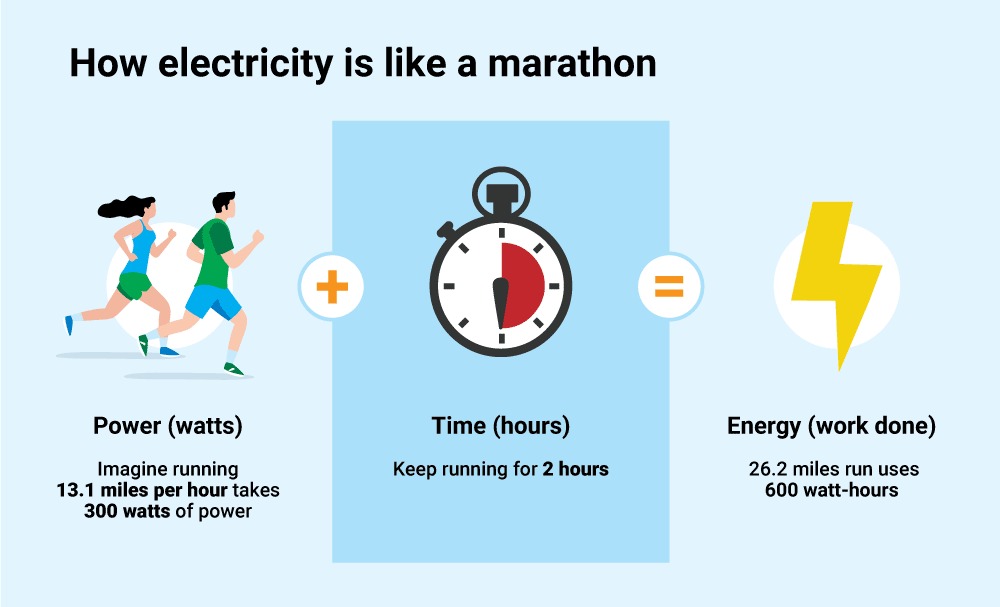
If we measured the runner’s consistent power output at about 300 watts, he would have expended 600 watt-hours over the 26.2 miles of the race. If he could run at the same power output for 5 hours, his total energy output would be 1,500 watt-hours or 1.5 kilowatt-hours.
kW and kWh on your electricity bill
As your home uses electricity during the day, a meter spins (or digitally counts up) to record the amount of power you use at all times. This measurement adds up to a certain number of kWh of energy consumption at the end of the month.
At the end of each billing cycle, the company “reads” your meter and records a total for energy usage. They then apply their fancy (and sometimes extremely complicated) calculations and bill you at a certain rate of cents per kWh.
Say you use 1,000 kWh per month, and your electric rate is $.15/kWh - your bill would be $150.00, plus any additional connection and service fees.
To make it extra complicated, some utilities also charge you based on your peak power demand during a month. The meter records the highest number of kW you used at any given time during the month, and you get assessed a fee per kW based on that number. Thankfully, these kinds of demand charges are mostly reserved for large commercial and industrial customers, but some homeowners could be affected by them.
How we use kW and kWh when talking about solar panels and home batteries
Electricity is created by solar panels when photons of light excite electrons in one layer of a panel’s surface. Those excited electrons are attracted by the other layer of the panel and will travel through a conductive wire to get to the other side. By diverting that travel through your home’s wires, solar electricity can be used to power your home.
Each solar panel is rated to convert a certain number of photons to electrons under full sun — i.e. put out a certain number of watts of Direct current (DC) power. The average peak power output of a solar panel these days is about 400 watts DC.
A typical solar system for a home needs about 15 of those panels, for a total rated output of about 6 kW of power. So when we say “a 6 kilowatt solar panel system,” we talk about the system’s maximum DC power output under ideal control conditions.
As for batteries, they use both kW and kWh. The amount of energy a home solar battery can hold is measured in kWh. But batteries need to serve that energy to the home, so the rate at which they can produce power is rated in kW.
How solar panels reduce your energy costs
Solar panels produce power to run your air conditioner, dishwasher, and other appliances and devices. Solar power reduces your energy bill by replacing electricity you would have otherwise bought from the utility company.
We know that a 6-kW solar panel system can produce that much power under full sun, but while the sun shines all day long, it’s technically only “full” at midday. During other parts of the day, the sun shines at a lower angle.
To return to the voltage/amperage discussion above, as soon as enough sun touches the surface of a solar panel, its full voltage is ready, but the number of photons exciting electrons is low, so its amperage (current) is low.
As the sun rises and shines more directly on the panel, the number of excited electrons increases up to the maximum, or full sun. If you look at solar energy production during the day, it looks like a bell curve with the lowest numbers at sunrise and sunset and a rounded peak in the middle.
To make it easier to understand how much energy a solar panel can make during the average day, people who study solar came up with the concept of peak sun hours.
They look at all the solar energy available in a given place on the earth over a whole year and divide it by 365 to get an average number of hours the sun would have to shine from its highest point in the sky to make that much energy.
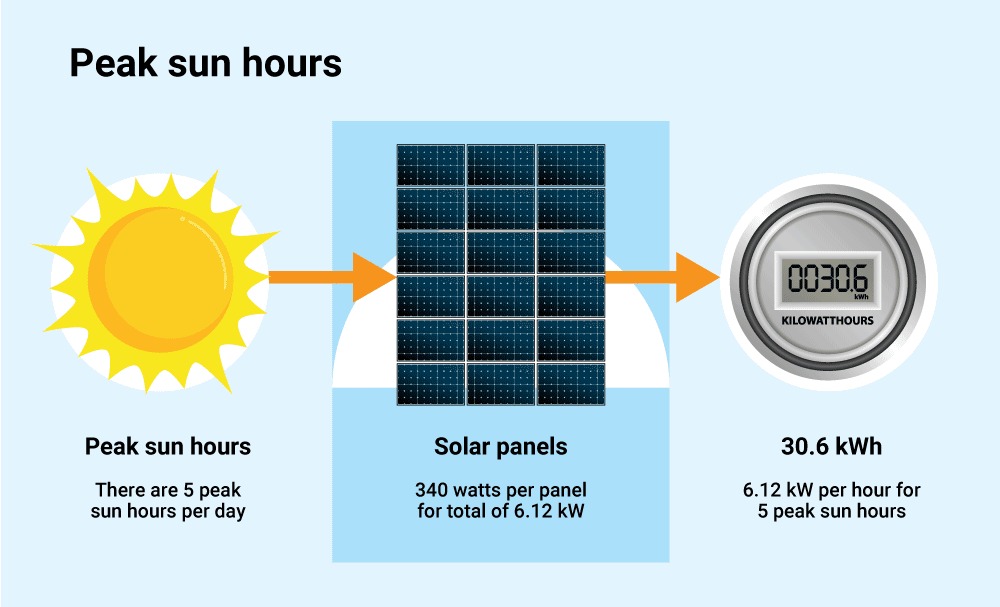
Say you live in an area with an average of 5 peak sun hours per day. Your 6-kW solar system could be expected to generate about 30 kWh of electricity on an average day. Of course, most days aren’t average, so it’s more likely that your system’s production will make more or less energy on any given day, but would end up at around 10,950 kWh per year (365 times 30 kWh/day).
Using our example above, a home that needs 12,000 kWh per year can reduce the amount of electricity they get from the grid down to just 1,050 kWh with our example 6-kW system and 5 peak sun hours per day. That represents a savings of $1,642.50 over that time period, thanks to solar.
How your state affects the value of solar energy
Every solar kWh is created equal, but unless you have net metering, they’re not all credited equally to your energy bill.
Net metering is a rule that ensures each kWh of solar energy gets full retail-rate credit on your bill. If your solar panels produce more than your monthly electricity usage, you earn a credit that is applied to the next month’s bill.
Learn more: What is net metering and how does it work?
Most states have net metering rules in place, but some don’t. Without full retail credit for the energy your solar panels make, going solar is not as financially advantageous.
Read our state solar guides to get information about net metering, and use the most accurate online solar panel calculator to see estimated cost and savings for solar panels on your specific roof.
Key takeaways
-
Watts and kilowatts are measures of power, or the ability to do work.
-
Kilowatt-hours are a measure of energy, or work done over time.
-
Appliances and devices use power to run, and keeping them running over time results in energy usage, which is measured and recorded as kilowatt-hours on your electric bill.
-
Solar panels make power, and the sun shining on them over time produces kilowatt-hours of energy that can reduce your electric bill by the number of kilowatt-hours produced.
Ben Zientara is a writer, researcher, and solar policy analyst who has written about the residential solar industry, the electric grid, and state utility policy since 2013. His early work included leading the team that produced the annual State Solar Power Rankings Report for the Solar Power Rocks website from 2015 to 2020. The rankings were utilized and referenced by a diverse mix of policymakers, advocacy groups, and media including The Center...
Learn more about Ben Zientara